Qualcomm announced the acquisition of SAM Seamless Network on July 8th, bringing it into its Connectivity, Broadband & Networking portfolio. One local Israeli media outlet reckons Qualcomm paid “more than$100 million”, another cites “more than $150 million.” Neither outlet attributes their number to any specific source. So what does Qualcomm really want with a provider of device intelligence and cybersecurity software for telcos and ISPs managing fleets of routers used in home networks and small businesses? And, depending on what the rationale is, what kind of sense does it make?
Let’s start with what does not make sense. HardenStance estimates that in 2025, telcos and ISPs world-wide spent just $40 million on home router security agents of the kind SAM sells. As cited in HardenStance’s “Telco Strategies for Consumer Security 2026” we expect this market to grow to $93 million by 2030. In terms of growing Qualcomm’s software revenues, SAM does tick a box of sorts. Besides the standalone Wi-Fi router market, Qualcomm is also seeing good momentum in the 5G FWA router market. But it’s highly unlikely that management wants nothing more from SAM than to continue targeting this relatively small telco and ISP market in ‘business as usual’ mode.
The telco zeitgeist favours unbundling or disaggregation
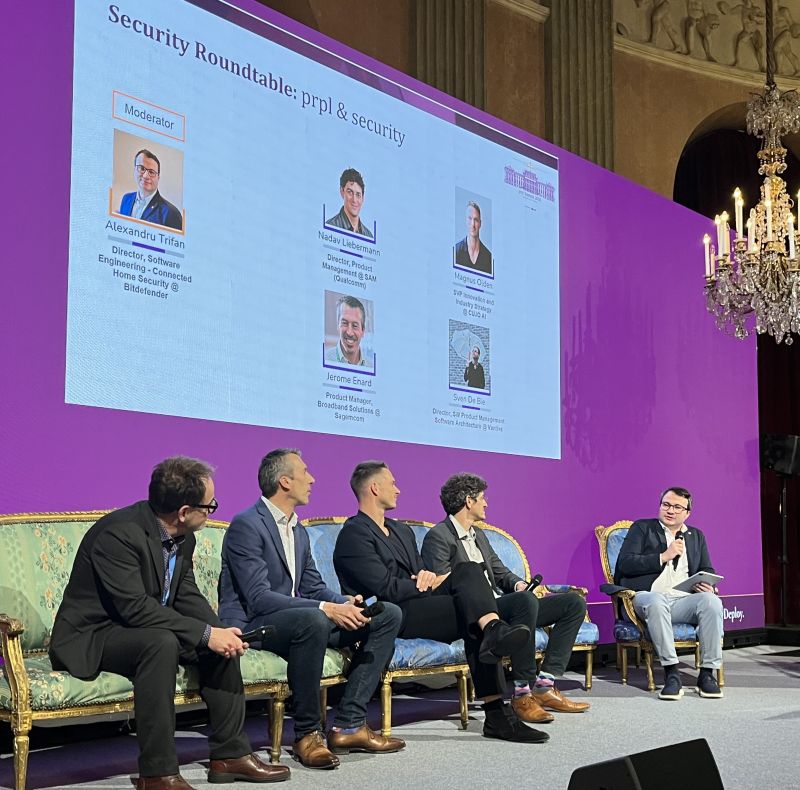
The most striking feature of the router market SAM serves is that telcos and ISPs are well down the road of unbundling or disaggregating hardware and software components via the open source RDK-B and prpl ecosystems. These are being driven by the carriers themselves – Comcast and Charter in the case of RDK-B; AT&T, Verizon and Orange in the case of prpl. RDK-B in particular has seen strong commercial momentum going back several years.
If management somehow believes it can sell a lot more chips into telco and ISP routers because they’re pre-integrated with SAM’s software, it looks like a pretty wild bet. The whole point of RDK-B and prpl is that telcos and ISPs want to manage one software application across their base of open-source routers, independent of the underlying hardware. A counter-intuitive bet against these open ecosystems could just about make some kind of sense if it’s targeting smaller telcos and ISPs. Many of these lack the operational resources to assemble and operationalize their own open-source solutions. Some of them could potentially be open to outsourcing the integration work to a single supplier, foregoing some of the benefits of an open ecosystem.
Another possibility is that Qualcomm now sees a substantial new opportunity in the U.S retail market. SAM’s embedded device intelligence and security could serve as a differentiator here.
Potentially, Qualcomm could also be betting on big tier 1 telcos being so exasperated with the time it’s taking to commercialize prpl at scale that they’re going to be amenable to tearing up much of the opensource ecosystem playbook too. That said, if that assumption really is in play in San Diego, I haven’t seen a single shred of evidence to support it. Following the FCC’s announcement in April that it is banning foreign-manufactured home routers from the U.S., another possibility is that Qualcomm now sees a substantial new opportunity in the U.S retail market. SAM’s embedded device intelligence and security could serve as a differentiator here.
But even if either or both of these designs on the small business and home router space form part of the strategy, they aren’t likely to be the primary drivers for acquiring SAM. View the opportunity from the perspective of Qualcomm’s scale and strategy rather than SAM’s narrow telco and ISP-centred go-to-market model, and there are many new directions spanning AI, cloud, device intelligence and security that SAM’s roadmap could now take. And this is a much bigger addressable market than just the $93 million telco and ISP segment.
Secure AI chips (or even AI-driven security chips)
Most obviously, Qualcomm’s new portfolio of AI chips will require competitive device intelligence and security features, almost irrespective of which industry vertical they are sold in to. SAM has potential to be a good baseline from which Qualcomm can build on. Flip that around and there may even be an opportunity to build an AI-powered cybersecurity chip. Across the IoT space, there’s value to Qualcomm in SAM’s ability to monitor and map the normal and abnormal behavioural profiles of specific devices, learning from multiple customer deployments. Also, regulators increasingly require minimum levels of cybersecurity in new IoT products sold into retail and business channels. For regulatory compliance, many IoT device vendors are open to vertically integrated solutions where chips come pre-integrated with security software in a way that most big telcos and ISPs are not.
One other option, albeit a long shot, is that Qualcomm could take SAM in the direction of better protecting telco security operations against cyber risk from the home network. Full disclosure: this is a HardenStance hobby horse. Rather than – or as well as – protecting the householder from cyber threats, home router security agents could be developed in the direction of providing telco security operations with intelligence that helps block the malicious outbound traffic from the home that increasingly threatens telco network availability and performance. There’s absolutely no indication of any kind that Qualcomm is thinking in this direction but it is one that any home router security agent vendor could potentially take.
The telco market is critical- hopefully Qualcomm sees it that way too
These are the directions I can think of Qualcomm potentially taking SAM in – there may well be others. Whatever direction Qualcomm takes, I hope it will maintain its commitment to the home router space for telcos and ISPs. As previously described, it’s a small but important market because telcos and ISPs are uniquely well placed to protect consumers against cyber threats. The current market leaders look to me to be CUJO AI® and Bitdefender. SAM, Allot and F-Secure Corporation are also in the mix while Plume, Airties and NAGRA have only recently entered the market. Hopefully, Qualcomm will continue to serve telcos and ISPs at the same time as it takes SAM’s software wherever else it wants to take it.